

If you’ve started looking at cross stitch fabric, you’ve probably noticed numbers like 14-count, 16-count, and 18-count Aida.
At first, those numbers can seem a little confusing. What do they mean? And does Aida count really matter when choosing fabric for your project?
Fortunately, Aida count is much simpler than it sounds. Once you understand what the numbers mean and how they affect your finished project, you’ll be able to choose the right cross stitch fabric with confidence.
If you haven’t already, be sure to read my Cross Stitch for Beginners Overview first.
Disclosure: As an Amazon Associate, I earn from qualifying purchases at no extra cost to you.
What Is Aida Fabric?
Aida is one of the most popular fabrics for cross stitch, especially for beginners.
It’s woven with a grid of small, clearly defined squares. Each square gives you a place to make one cross stitch, making it much easier to follow a counted pattern.
Aida is available in different counts and colors, but the count is the part that matters most when you’re deciding what fabric to use.
What Does “14-Count” or “18-Count” Mean?
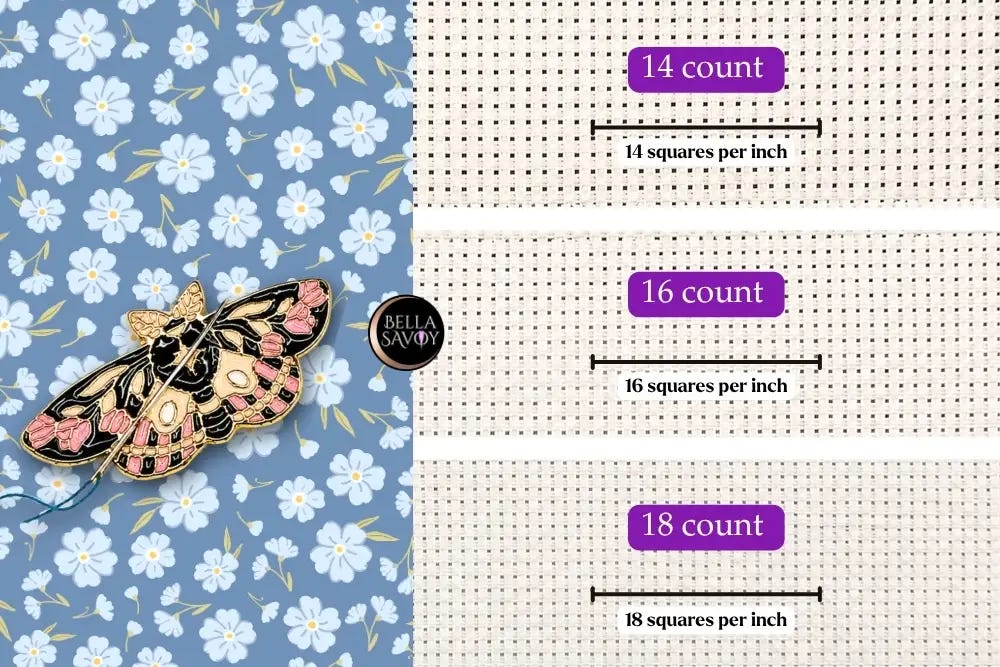
The number tells you how many stitchable squares fit across one inch of fabric.
For example:
14-count Aida has 14 squares per inch.
16-count Aida has 16 squares per inch.
18-count Aida has 18 squares per inch.
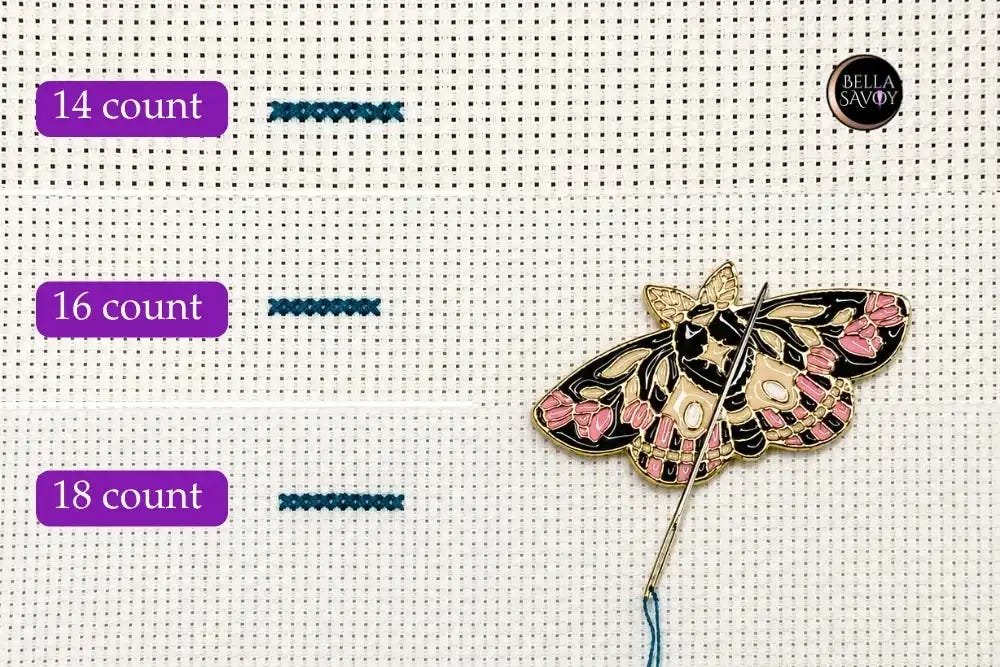
Because more squares are packed into each inch as the count gets higher, the individual stitches become smaller.
So the easiest way to remember it is:
Lower count = larger stitches
Higher count = smaller stitches
How Does Aida Count Affect the Finished Size?
The fabric count also determines how much space your finished design will take up. The same pattern will be larger on a lower-count fabric and smaller on a higher-count fabric.
For example, imagine a pattern that is 50 × 50 stitches:
On 14-count Aida, it will be about 3.6 × 3.6 inches
On 18-count Aida, it will be about 2.8 × 2.8 inches
You’re still making exactly 50 × 50 stitches. The only difference is the size of the squares on the fabric.
If you want to calculate the stitched size of another pattern, simply divide the number of stitches by the fabric count.
Stitch count ÷ fabric count = approximate stitched size in inches
Calculate the width and height separately.
Remember: Stitched Size Isn’t Fabric Size
If your finished design will measure 3.6 × 3.6 inches, you don’t want to cut a 3.6 × 3.6-inch piece of Aida.
You’ll need extra fabric around the design so you have room to stitch comfortably and finish your project later.
How much extra you need depends on whether you’re framing the piece, putting it in a hoop, making an ornament, or using another finishing method.
When you’re unsure, it’s better to have a little too much fabric than not enough.
Which Aida Count Should You Choose?
For most beginners, 14-count Aida is a great place to start. The squares are relatively large and easy to see, and the finished design will be larger.
But there’s no rule saying you have to start with 14-count.
14-Count Aida
A good choice if you:
Are completely new to cross stitch
Prefer larger, easier-to-see stitches
Want a larger finished design
16-Count Aida
A nice middle ground if you want stitches that are a little smaller than 14-count without making a big jump in size.
18-Count Aida
A good choice if you want a smaller finished project or prefer the look of finer stitches.
You don’t have to be an expert to use 18-count. If you’re comfortable seeing and counting the squares, you can use it.
I personally love how designs come out with 18 count but it’s very hard on my eyes if I don’t use my magnifying glass.
The easiest way to choose
Think about the finished size you want. Want the design larger? Choose a lower count. Want the design smaller? Choose a higher count.
If you’re unsure, 14- or 16-count Aida is a simple place to begin, but I highly recommend trying the 14 count first.
What About Other Aida Counts?
14, 16, and 18 count are common choices, but you’ll also find Aida in other counts, such as 11-count and 20-count.
The same basic rule always applies: The lower the count, the larger the stitches. The higher the count, the smaller the stitches.
So you can use the count to adjust the overall size and appearance of your project.
What About Evenweave and Linen?
Once you start exploring cross stitch, you may come across evenweave and linen.
Unlike Aida, these fabrics don’t have the same obvious block-style grid. Cross stitch is often worked over two fabric threads instead of over one Aida square.
You may see something described as 28-count evenweave, over two.
For finished-size purposes, that is equivalent to 14-count Aida because you’re working over two threads.
Similarly:
28-count over two = 14-count equivalent
32-count over two = 16-count equivalent
36-count over two = 18-count equivalent
You don’t need to use evenweave or linen to get started with cross stitch. Aida is usually the simplest choice for beginners because its grid makes counting easier.
What Color Aida Should You Choose?
Aida comes in much more than white.
You’ll find colors ranging from cream and soft neutrals to pastels, gray, black, and many other shades.
For your first project, a light neutral such as white, ivory, or cream can make the fabric holes easy to see.
Once you’re comfortable with cross stitch, experimenting with colored Aida can be a fun way to change the look of a design without changing the pattern itself.
Quick Aida Count Cheat Sheet
If you remember nothing else, remember this:
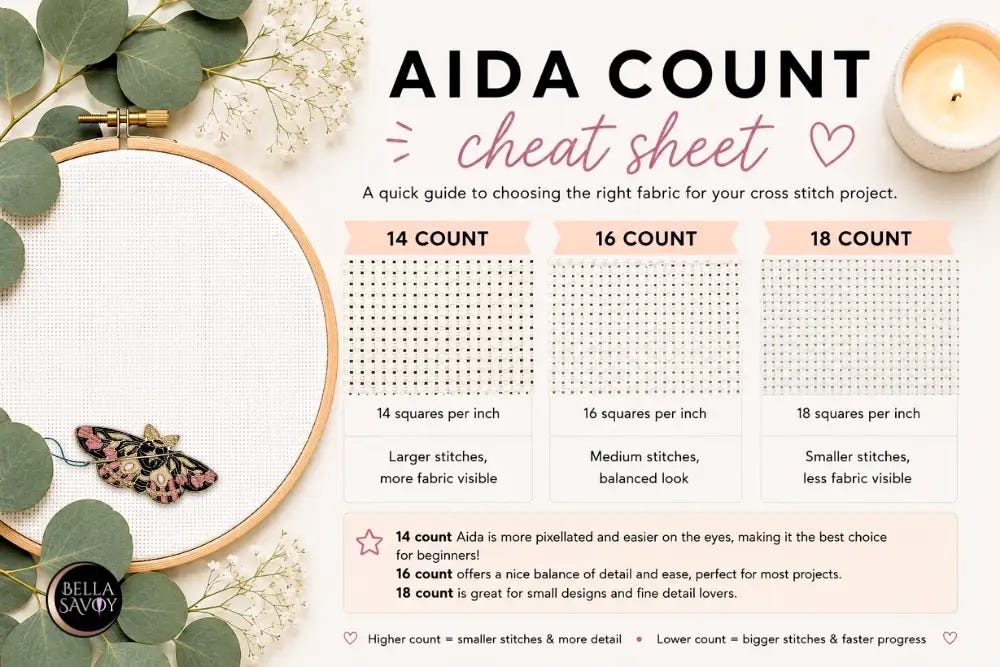
14-count: larger stitches, larger finished design
16-count: medium-sized stitches and finished design
18-count: smaller stitches, smaller finished design
And:
Lower count = larger design
Higher count = smaller design
That’s all you really need to know to make a good fabric choice.
Ready to Learn How to Read Your Pattern?
Now that you understand the fabric, the next step is learning how to make sense of the pattern itself.
In the next upcoming post: How to Read a Cross Stitch Pattern: A Beginner’s Guide, we’ll look at charts, symbols, color keys, stitch counts, and how to keep your place as you work.
Once you understand both the fabric and the pattern, you’ll have the two basic pieces of information you need to start stitching with confidence!