

Starting cross stitch is pretty simple once you get the basics down. You have your fabric, thread, needle, and a pattern to follow—and before long, you’re making little X’s across the fabric.
But there are a few things that aren’t always obvious when you’re first learning. Some are tiny details that make stitching easier, while others can save you a lot of frustration once you start working on your first few projects.
I’ve put together 13 cross stitch tips for beginners that I wish I had known when I first started. None of them are complicated, but they can make your first projects a little easier and a lot more enjoyable.
Disclosure: As an Amazon Associate, I earn from qualifying purchases at no extra cost to you.
1. Start With a Small, Beginner-Friendly Pattern
One of the easiest ways to make cross stitch feel harder than it needs to be is to start with a project that’s too big or too complicated.
For your first project, look for a pattern that’s less than 40 × 40 stitches. That’s a manageable size for learning the basics without feeling like you’ve signed yourself up for a project that will take forever.
Size isn’t the only thing to consider, though. When choosing your first pattern, look for one that:
Uses a manageable number of colors
Has clear, easy-to-follow symbols
Doesn’t have a lot of confetti stitching (individual stitches scattered throughout the design)
Doesn’t rely heavily on fractional stitches or complicated details
Looks like something you’ll actually enjoy stitching
A simple design that you’re excited about and can finish is a much better choice than a complicated pattern you picked because you thought it looked impressive.
2. Count Carefully Before You Stitch
One of the easiest ways to make a cross stitch project frustrating is to start stitching in the wrong place.
Before you make your first stitch, take a moment to check your starting point against your pattern. Count the spaces around it and make sure you’re following the correct symbols and colors.
When you’re starting a new section, count the spaces around your stitches before you begin. If you’re unsure, count again.
It might feel like you’re slowing yourself down, but a quick check now can save you from having to undo a whole section later.
3. Check Your Work as You Go
You don’t have to wait until you’ve finished a whole section—or an entire project—to compare your stitching with the pattern.
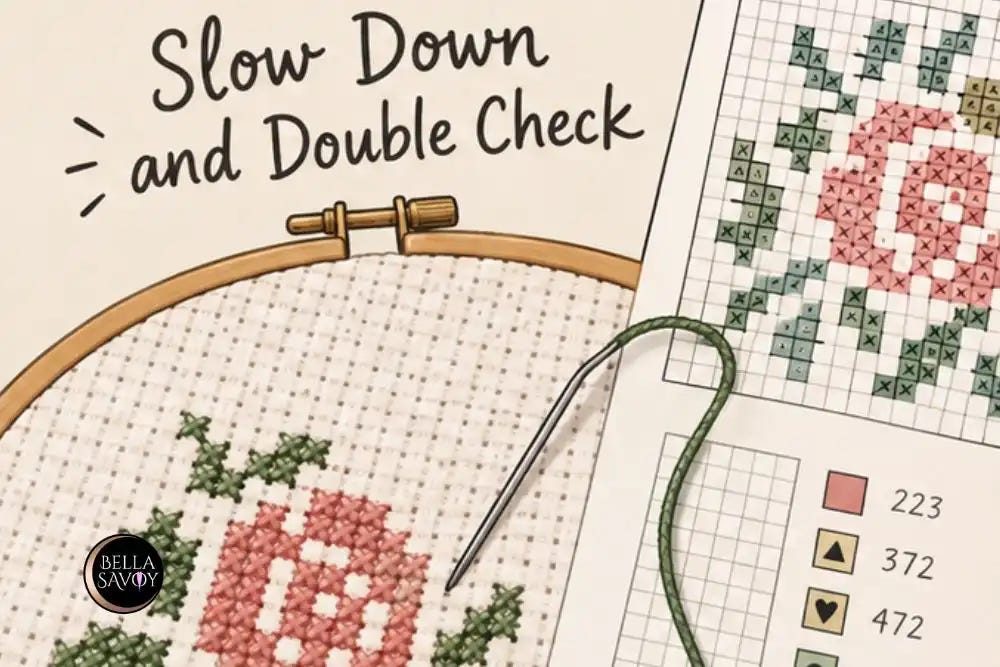
Every so often, pause and look at your work alongside the chart. Make sure the stitches are where they should be and that you’re still following the correct symbols and colors.
I actually use a timer for this. Every 15 minutes, I stop and check my work against the pattern. It only takes a moment, and it can save you from discovering a mistake after an entire evening of stitching.
This is especially helpful when you’re working on a pattern with lots of similar-looking areas.
If you’re using a paper pattern, marking off completed sections can also make it easier to see where you left off. One of my favorite apps for this is Pattern Keeper, which lets you keep track of your progress digitally as you work.
4. Keep Your Crosses Going the Same Direction
Your finished cross stitches will look much neater when all of the top stitches lie in the same direction.
For example, if the top half of your first cross goes from bottom-left to top-right, keep that same direction throughout the project.
This may seem like a small thing, but it makes a surprisingly big difference once you have a whole section stitched.
If your stitches aren’t perfectly identical at first, don’t worry. You’re learning! With a little practice, keeping your stitches consistent will become second nature.
5. Find the Right Thread Tension
Your thread should lie comfortably on top of the fabric without pulling or puckering it. Think snug, not tight.
It’s tempting to pull your thread firmly after every stitch, especially when you’re trying to make everything look neat. But cross stitch doesn’t need to be pulled tight.
If you pull too hard, you can distort the holes in the fabric and cause the fabric to bunch up. Your stitches may also look uneven.
This is one of those things that gets easier with practice. Eventually you’ll develop a feel for how much tension your thread needs.
6. Give Your Thread Some Room
It can be tempting to cut a really long piece so you don’t have to stop and start new thread as often, but longer thread has more opportunities to twist around itself.
A shorter length is much easier to manage, especially when you’re new to cross stitch.
And if your thread starts twisting while you’re stitching, let the needle hang for a moment and allow the thread to unwind. This simple trick can save you from a frustrating knot.
7. Keep the Back Tidy, Not Perfect
A tidy back is nice, but it doesn’t have to be perfect for your project to turn out beautifully. If you’re new to cross stitch, don’t get caught up in trying to make every thread on the back look perfectly organized.
The front is what you’ll see when your project is finished, so that’s where your attention should be. A few little tangles or imperfect threads on the back aren’t going to ruin your stitching.
That said, try to avoid large knots and unnecessarily long pieces of thread traveling across the back of your design. They can make the back bulky and, especially with darker colors, may show through to the front.
8. Start in the Center and Leave Enough Fabric
Starting near the center of your design makes it much easier to keep your finished piece properly positioned on the fabric. Once you’ve found the center of your pattern and fabric, you can work outward and know you’re not slowly drifting toward one edge.
Before you begin stitching, make sure you’ve also left enough fabric around your design.
How much extra fabric you’ll need depends on how you plan to finish your project, so it’s worth thinking about that before you make your first stitch.
And don’t forget to wash and dry your hands before you start, especially if you’re working with light-colored fabric. Oils and lotion from your hands can transfer to the fabric as you stitch.
9. Use the Right Number of Floss Strands
Embroidery floss is made up of six individual strands, but you will rarely stitch with all six.
Your pattern should tell you how many strands to use. For example, if it calls for two strands, separate two strands from the floss before stitching.
Using too many strands can get bulky and make it difficult to pull the thread smoothly through the holes in your fabric.
This is easy to overlook when you’re first starting out, especially if you’ve never worked with embroidery floss before. Using the correct number of strands helps give your finished stitches the look and coverage the designer intended.
10. Start and Secure Your Thread Without Knots
It might seem natural to tie a knot at the end of your thread to keep it from pulling through the fabric, but knots can create bumps on the back of your work and may even show through on the front.
There are several ways to start and secure your thread which I go over in my post:
11. Keep Your Thread and Pattern Organized
A little organization can make your stitching much easier to follow.
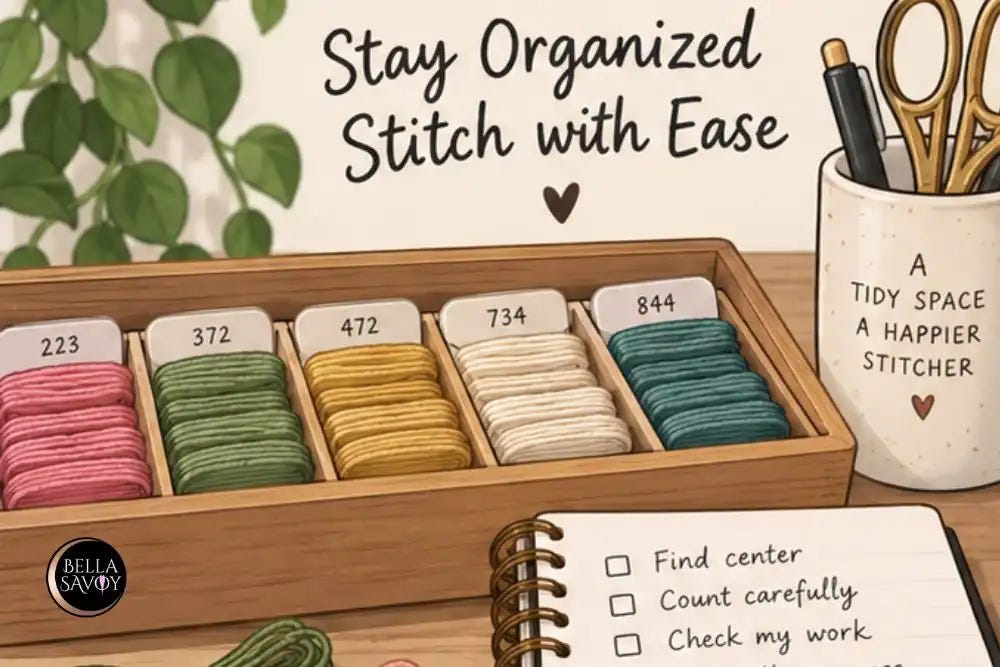
When you need to move the same color a short distance across the back, it’s fine to carry the thread. But for longer distances, it’s better to finish your thread and start a new one.
It also helps to work through your pattern in smaller sections rather than jumping around too much. This makes it easier to keep your place and avoid accidentally skipping stitches.
12. Take Breaks, Rest Your Eyes, and Check Your Lighting
Cross stitch requires a lot of close-up concentration, especially when you’re working on smaller designs. It’s easy to get caught up in a project and suddenly realize you’ve been stitching for hours.
Take regular breaks, stretch your hands, and look away from your work to give your eyes a rest. I also find good lighting makes a huge difference. I use a hands-free OttLite magnifier when I stitch, and it’s saved my eyes, especially when I’m working with smaller stitches.
If you’re squinting to see your fabric or distinguish between colors, try moving somewhere brighter or adding a good task light or magnifier. And if you’re feeling tired or frustrated, it’s perfectly fine to put your project down and come back to it later.
Cross stitch is supposed to be relaxing, so give yourself permission to take a break and enjoy the process.
13. What to Do When You Make a Mistake
You will make a wrong stitch eventually. Everyone does.
Maybe you counted incorrectly, used the wrong color, or suddenly realized you’re one square off.
Take a breath.
If you catch the mistake early, you can usually carefully undo the stitches and try again. Use your needle to loosen the stitches rather than cutting them with your scissors, since cutting too close to the fabric can accidentally damage it.
And sometimes a mistake is so small that you can simply leave it alone. Not every imperfect stitch needs to be fixed.
Give Yourself Permission to Learn
Your first cross stitch project isn’t supposed to look like it was made by someone who’s been stitching for twenty years.
You might miscount, have to undo a few stitches, or end up with stitches that aren’t quite perfect. That’s okay. You’re learning.
The more you stitch, the more comfortable you’ll become with your tension, counting, and thread. You’ll also discover the little techniques that work best for you—because there isn’t one “right” way to enjoy cross stitch.
Download My Free Cross Stitch Pattern
Now that you know a few of the things that can make your first cross stitch project a little easier, why not put them into practice?
Download my free cross stitch pattern — I designed it to be beginner-friendly and to help you get comfortable with your stitches and your pattern.
When you’re ready for something a little bigger and more fun, sign up for my newsletter and I’ll send you another free beginner-friendly cross stitch pattern to add to your stitching queue.
Grab your pattern, make yourself a cozy drink, and enjoy your first few stitches. You don’t have to get everything perfect—just have fun and see where those little X’s take you.